
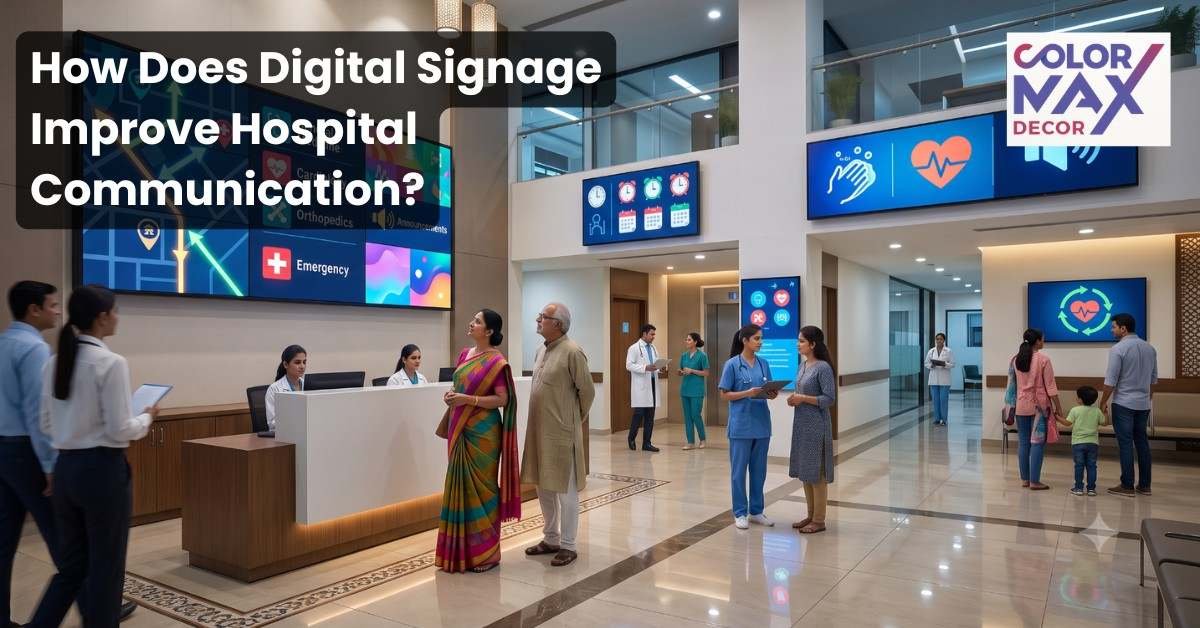
Hospitals handle a continuous flow of information every day. Patients, visitors, doctors, nurses, and support staff need quick access to directions, announcements, appointment details, safety instructions, and service information.
Traditional signs work well for permanent messages, but updating them whenever information changes can be difficult. Digital signage offers a flexible alternative by allowing hospitals to change and manage displayed information more efficiently.
Making Hospital Navigation Easier
Large hospitals can be confusing, especially for first-time visitors. Multiple departments, diagnostic centres, emergency areas, pharmacies, consultation rooms, and waiting zones can make navigation challenging.
Digital displays can show department names, floor numbers, arrows, maps, and directional instructions. When positioned at entrances, corridors, lifts, and key decision points, they can help visitors find their destinations more easily.
This can also reduce repeated directional enquiries at reception desks, allowing staff to focus on patients and other important responsibilities.
Sharing Real-Time Information
Hospital communication is not limited to wayfinding. Screens can display visiting guidelines, appointment information, health awareness messages, emergency instructions, service updates, and general announcements.
When information changes, authorised staff can update the content without replacing printed signs. This makes digital communication particularly useful for time-sensitive information.
Keeping Patients and Visitors Informed
Waiting areas provide an opportunity to communicate useful information. Instead of displaying the same static notice, digital screens can rotate between relevant messages.
Hospitals can use this space for health awareness content, service information, general instructions, or important announcements. The content can also be scheduled according to different times of the day.
Reducing Information Overload
Hospitals already contain many signs, posters, and instructions. Adding too much information to digital screens can make communication harder rather than easier.
Effective displays should focus on short, clear messages. Important information should receive priority, while secondary content can appear through controlled rotations.
Font size, contrast, spacing, and viewing distance also matter. Visitors should be able to understand a message quickly without having to stand directly in front of the screen.
Improving the Visitor Experience
Hospital visits can be stressful, particularly for patients and their families. Confusing directions or unclear information can increase that stress.
Well-planned digital signage can make the environment easier to understand by helping visitors locate departments, follow instructions, and stay informed while waiting.
It does not replace staff assistance. Instead, it can handle routine communication so employees can give more attention to people who require direct support.
Supporting Different Hospital Areas
Different areas of a hospital require different types of communication. Reception areas may need welcome messages and directions, while waiting rooms can focus on health information and announcements.
Corridors can prioritise wayfinding, whereas emergency areas require highly visible and straightforward instructions. The content and display format should therefore match the purpose of each location.
Managing Content Properly
Installing screens is only the beginning. The information displayed must remain accurate, relevant, readable, and up to date.
Hospitals should have a clear process for reviewing and approving content. Outdated department names, incorrect timings, or expired announcements can create confusion and reduce trust in the information being provided.
Accessibility should also be considered. Clear typography, sufficient contrast, concise wording, and suitable screen placement can make communication easier for different age groups and visitors with varying needs.
Choosing the Right Technology
The right digital signage system depends on the hospital’s environment and communication requirements. Screen size, brightness, viewing distance, connectivity, durability, content management, and maintenance should all be evaluated before installation.
A display suitable for a reception area may not work equally well in a bright corridor or semi-outdoor space. Choosing technology based on actual requirements helps ensure that the investment provides practical value.
Why Proper Placement Matters
Even a high-quality display will have limited impact if people cannot easily see it. Screens should be positioned where visitors naturally look for information, such as entrances, reception areas, corridors, lift zones, and major intersections.
Viewing height and distance should also be considered. The goal is to make important information visible and understandable without forcing people to stop for an extended period.
Conclusion
Digital signage can make hospital communication more flexible, organised, and responsive. It can support wayfinding, announcements, health awareness, service information, and everyday visitor communication.
However, effective results depend on more than installing screens. Clear content, strategic placement, suitable technology, accessibility, regular updates, and proper maintenance are equally important.
When these elements are planned together, digital signage becomes a practical communication tool that can reduce confusion, support hospital staff, and create a more informed visitor experience.